As an industry-leading, integrated solution provider, Lummus Digital offers a diversified technology portfolio for the Oil & Gas sector, built upon the AI/ML capability of the mcube™ platform. Our digital solutions address the operating challenges across the refinery, enabled by the deep experience of partner companies Lummus Technology and CLG.
Digital solutions for the refinery cater to the various stages of asset lifecycle for operations and maintenance. Our solutions empower our global customers across the Oil & Gas sector by adding to their bottom line with payback of less than 6 months and an ROI of 50%+ in most cases.

CDU/VDU Optimization
Digital optimization boosts the efficiency of the crude and vacuum distillation units (CDU/VDU) by reducing losses, improving side-stream yields and unlocking cost savings across your operations.
At the core of this optimizer is a hybrid AI model designed to maximize the flow rates of Side Stream 1, Side Stream 2, and SPVGO by optimizing the movement of the Vacuum Tower Bottom (VTB) product into the column’s middle section. Leveraging real-time DCS data, it ensures that viscosity, flash point, and VTB penetration number remain within specification limits.
With real-time predictions of downstream quality parameter values and improved product recovery, your operations are transformed with enhanced efficiency and profitability!
Pain Point
Crude Blend Uncertainty
Benefit
Crude Mix Clarity: Our crude mix model accurately determines the processed blend by integrating analyzer API values with user-provided crude mix data.
Pain Point
Unstable Operation During Crude Changeovers
Benefit
Dynamic Crude Optimization: The model adapts to varying crude blends, providing optimized set points for each combination, ensuring smooth operations and stability.
Pain Point
Loss of High-Value Streams
Benefit
Maximized Product Value: The model optimizes VTB blending with higher-value middle streams, keeping all quality parameters within spec limits to maximize profitability.
Pain Point
Low Frequency Sampling of Side-Streams and Vacuum Tower Bottom
Benefit
Real-Time Quality Predictions: Our model delivers high-frequency, real-time predictions of key quality metrics, enabling faster, more accurate control.
Performance Metrics
Performance Deviation Prediction
Operator enters the estimated crude mix on the dashboard and initiates the run.
Key Parameter Monitoring
The Crude Mix Model calculates the accurate crude mix and displays the results on the dashboard.
Process and Efficiency Trends
Every two hours, the prediction model runs to predict the Viscosity, Flash Point, and VTB Penetration Test values at operating conditions.
Operational Benchmarking
Using the corrected crude mix and predicted product quality parameters, the Optimizer Model runs and populates a table of actual and optimized/recommended values.
Actionable Insights for Improvement
A comparison plot between “Current Operation” and “Optimized Operation” is displayed on the dashboard for operator action.
Hydrocracker Optimization
Hydrocracker Optimization delivers maximum conversion by utilizing DCS and Feed Quality data in real time. The AI/ML platform defines essential DCS setpoints and recommendations for plant operators and process engineers, enabling consistent achievement of target conversion rates.
Our model begins by accurately predicting the maximum achievable conversion, leveraging feed quality detail from Stage 1 and Stage 2, such as distillation profile, sulfur content, nitrogen, and asphaltenes. The optimizer then generates precise DCS operator setpoints—such as Heater COT, Reactor CAT, and hydrogen flow—enabling operators to achieve optimal conversion efficiently and process reliability.
Pain Point
Unclear Potential Conversion
Benefit
Dynamic Target Conversion: Instantly adjusts to feed quality changes.
Pain Point
Inability to Boost Reactor Performance Without Vacuum Tower Fouling
Benefit
Optimized Reactor Efficiency: Utilize our Conversion and SHFT model to boost conversion while minimizing vacuum tower fouling.
Pain Point
Insufficient Stage 2 Feed and Product Quality values
Benefit
Pain Point
High Hydrogen Consumption
Benefit
Reduced Excess H2: Lower H₂ consumption during operations.
Performance Metrics
Performance Deviation Prediction
Utilizes Stage 1 and Stage 2 Feed LIMS data to predict the quality parameters of both Stage 1 and Stage 2 products.
Key Parameter Monitoring
- Fixed Conversion
- Maximum Conversion
Process and Efficiency Trends
Using Stage 1 and Stage 2 Feed Quality data, the model calculates the potential conversion achievable for the given feed quality.
Operational Benchmarking
The model runs and publishes recommended values for operator-controlled setpoints required to achieve maximum possible conversion.
Actionable Insights for Improvement
A comparison plot of Current Operation vs. Recommended Operation is displayed on the dashboard.
Hydrocracker
Optimization
LC-Fining
LC-Fining
The hybrid digital solution for LC-FINING optimization integrates physics-based models with advanced data analytics to optimize reactor performance. By dynamically adjusting key parameters—such as temperature and hydrogen flow—and combining real-time plant data with insights into thermodynamics and reaction kinetics, it maximizes product yields, reduces energy consumption, and extends catalyst life. Operators can simulate multiple feedstock scenarios, enabling smarter, data-driven decision-making.
Implement digital solutions to enable increased conversion, real-time predictions of downstream SHFT values, and optimized hydrogen consumption, transforming your operations for enhanced efficiency and profitability.
Pain Point
Unclear Potential Conversion
Benefit
Dynamic Target Conversion: Instantly adjusts to feed quality changes for accurate conversion targets.
Pain Point
Reactor Performance Limited by Vacuum Tower Fouling
Benefit
Optimized Reactor Efficiency: Utilize our Conversion and SHFT model to boost conversion while minimizing vacuum tower fouling.
Pain Point
Insufficient Vacuum Residue SHFT Values
Benefit
Hourly Insights on Vacuum Residue: Leverage our SHFT model for real-time predictions of vacuum residue values.
Pain Point
High Hydrogen Consumption
Benefit
Reduced Excess H2: Lower H₂ consumption during operations.
Pain Point
Reduced Conversion Efficiency Lowers Valuable Product Yields
Benefit
Optimizing temperature and hydrogen flow boosts reactor performance, increasing diesel and naphtha yields while enhancing efficiency and minimizing waste.
Pain Point
Increased Residues Strain Resources
Benefit
Advanced analytics and thermodynamic insights reduce residue, lowering energy and hydrogen consumption while minimizing equipment wear and extending its lifespan.
Pain Point
Catalyst Deactivation Leads to Higher Maintenance Costs and Reduced Refinery Flexibility
Benefit
Extended Catalyst Life: Minimize residue formation and thermal stress using predictive analytics, which reduces wear, maintenance costs, and operational downtime.
Performance Metrics
Performance Deviation Prediction
Key Parameter Monitoring
The Operator can select the mode of Optimization as
- Fixed Conversion
- Maximum Conversion
Process and Efficiency Trends
Using the FOI and predicted SHFT Value, the model calculates the Potential Conversion that can be achieved for the given Feed Quality.
Operational Benchmarking
The model generates and publishes recommended operator-controlled setpoints required to achieve maximum possible conversion.
Actionable Insights for Improvement
The dashboard displays a comparison plot of “Current Operation” vs. “Recommended Operation”, enabling clear visibility into performance gaps and improvement opportunities.
Ethylene/Propylene Optimization in the FCC
Ethylene/Propylene Optimization in the FCC
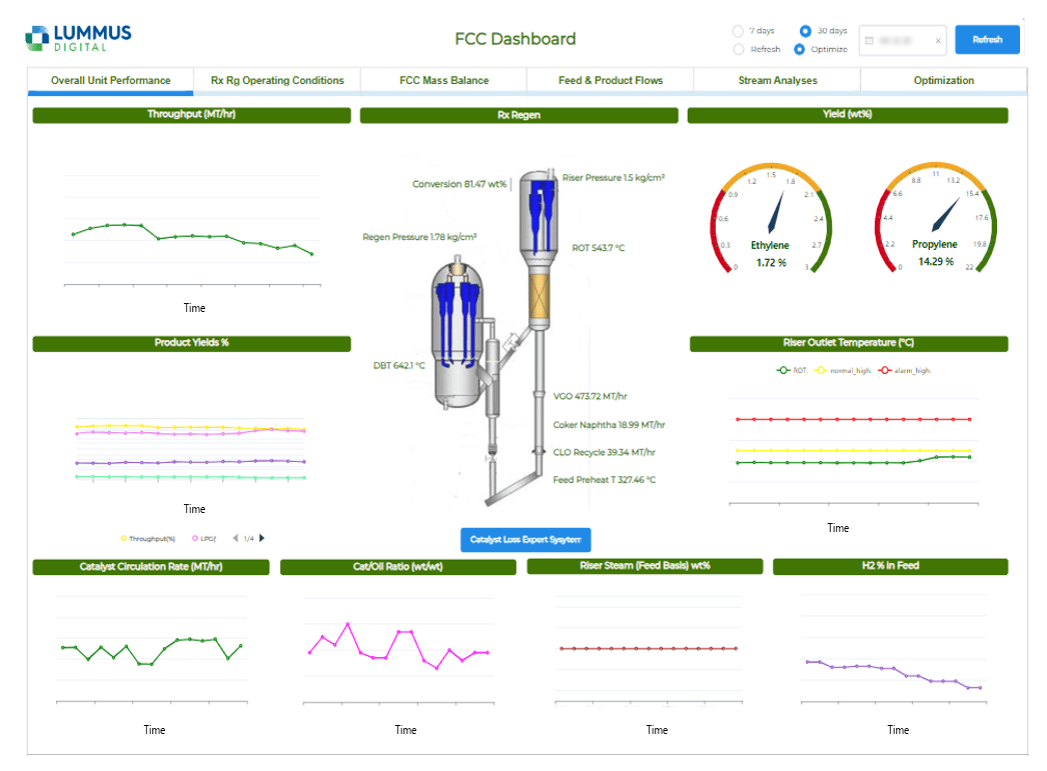
This solution uses an AI/ML platform to maximize ethylene and propylene yields in FCC operations. Our model provides precise operator setpoints for optimizing key variables in either fixed or variable riser operating temperature scenarios adjusting riser pressure; dispersion steam rate; coker naphtha recycle rate; and dense bed temperature.
Pain Point
Yield Limitations at Maximum Riser Operating Temperature (ROT)
Benefit
Fixed ROT Maximization Optimizer: Provides insights into possible yield increases for both ethylene and propylene.
Pain Point
Uncertainty in Optimization Mode Selection
Benefit
Dual ROT Optimization: Evaluates both fixed and variable ROT scenarios to reveal potential yield improvements.
Performance Metrics
Performance Deviation Prediction
DCS and LIMS data for both feed and product streams are captured, providing essential input for analysis and optimization.
Key Parameter Monitoring
Operators select the optimization mode—Fixed ROT or Variable ROT—to maximize ethylene and propylene (E+P) yield
Process and Efficiency Trends
The optimizer runs hourly based on the last selected optimization mode and the latest DCS and LIMS data, ensuring up-to-date analysis.
Operational Benchmarking
The Results from the optimizer are published on the Dashboard table.
Actionable Insights for Improvement
Comparison plot between “Current Operation” vs. “Optimized Operation“ is shown on the Dashboard.
LOBS Optimization
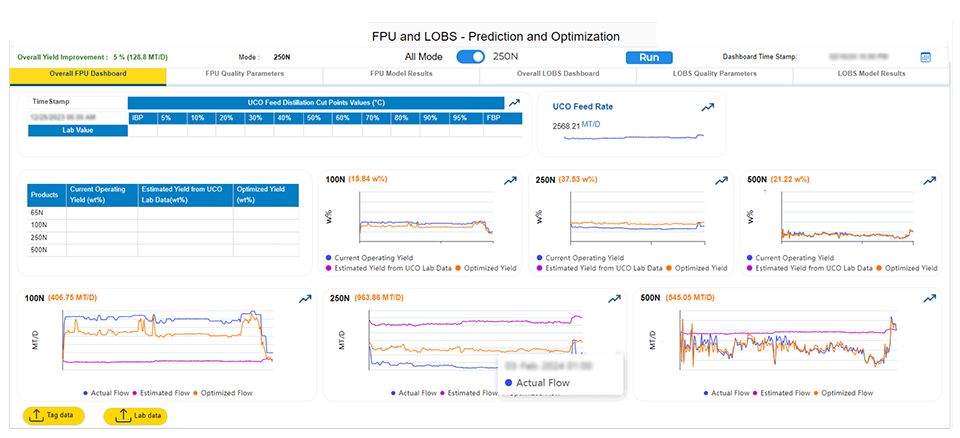
Elevate your production with the LOBS Optimization Advisor—an advanced AI/ML-powered platform engineered to maximize a particular grade cut yields from the FPU and significantly boost lube oil output from the LOBS unit.
Our hybrid model empowers operators with precise setpoints to optimize critical variables in both the FPU and LOBS sections, driving maximum 250N cut yields.
Pain Point
Loss of 250N Yield Potential
Benefit
Enhanced 250N Cut: The model maximizes 250N yield in FPU and boosts 250N lube oil output in LOBS, ensuring maximum product recovery and profitability.
Pain Point
Delayed Detection of Side-Stream Quality Variations
Benefit
High-Frequency Quality Tracking: Real-time sampling of viscosity and pour point in side streams enables precise quality control and rapid adjustments, maintaining optimal output specifications.
Performance Metrics
Performance Deviation Prediction
The operator enters the UCO Feed Quality (Distillation Sample) data on the dashboard for analysis of the feed quality parameters.
Key Parameter Monitoring
The Expected Yield model calculates the expected yields for 65N, 100N, 250N and 500N streams of the FPU and LOBS.
Process and Efficiency Trends
Every hour, the prediction model runs to predict the Viscosity of all side streams, and the formula calculates the Viscosity Index
Operational Benchmarking
Every hour, the prediction model runs to predict the Viscosity of all side streams, and the formula calculates the Viscosity Index.
Actionable Insights for Improvement
Comparison plot between “Current Operation” vs. “Optimized Operation“ is shown on the Dashboard.
Dew Point Prediction and Optimization
Dew Point Prediction and Optimization
Hybrid modeling is a key solution to improve the accuracy of dew point predictions, ensuring optimal conditions for maintaining “On-spec” product quality and avoiding costly operational decisions that impact run time and maintenance costs.
Product Stripper dew point issues often create significant operational hurdles, including off-spec products, hydrocarbon condensation, and decreased throughput. These challenges lead to inefficiencies in separation processes, adversely affecting product quality and escalating reprocessing costs.
To mitigate these issues, operators often increase reboiler heat, resulting in higher energy consumption and diminished plant efficiency.
Additionally, dew point mismanagement can lead to equipment fouling, corrosion, and potential damage to downstream compressors from liquid carryover. This not only drives up maintenance costs and unplanned downtime but also introduces environmental and safety risks associated with venting or flaring.
By addressing dew point management effectively, refineries can enhance performance, reduce costs, and maximize profitability.
Pain Point
Steam Condensation Risks and Fouling Problems
Benefit
Real-time monitoring and adjustments enable operators to maintain optimal operating conditions, enhancing process stability, boosting productivity by 10%, and delivering an annual revenue increase of $100,000 alongside total savings of approximately $250,000.
Pain Point
Unplanned Shutdowns and Increased Maintenance Frequency
Benefit
Optimize energy usage and enhance the equipment lifespan with actionable recommendations based on AI-driven insights and hybrid model approaches.
Pain Point
Lack of Proactive Management
Benefit
Predictive insights inform maintenance schedules, enabling proactive measures to address potential issues and extend equipment life by 20%, saving a medium-sized industrial plant approximately $150,000 annually based on a $750,000 replacement cost every five years.
Performance Metrics
Performance Deviation Prediction
Calculate the dew point with precision and suggest the most optimal top temperature settings to prevent steam condensation from occurring during the process.
Key Parameter Monitoring
Complete monitoring of all parameters, including Naphtha flow, off-gas flow, reflux flow, steam flow, top pressure, and top temperature.
Process and Efficiency Trends
Trend plots for
- Dew point
- Overhead temperature
- Top pressure & Partial pressure
- Reflux flow, Off-gas flow, and Naphtha flow
Operational Benchmarking
Comparison plot and table between “Actual” vs. “Recommended “ for
1. Overhead Temperature
2.Reflux Flow
3.Stripping Steam Flow
Actionable Insights for Improvement
Actionable recommendations (based on comparison with current values) on controllable parameters such as reflux flow and stripping steam flow.
Operational reliability can be improved using digital solutions for:

Anomaly
Detection
Using supervised and unsupervised machine learning, to determine contributing factors for the anomalous behavior of the equipment

Root Cause
Identification

Prediction of Failures Ahead of Occurrence
Using deep learning Long Short-Term Memory (LSTM) of the networks, the prediction of anomalies and remaining time before equipment failure