Lummus Digital enables intelligent plant operations by combining deep process expertise with AI and advanced data analytics. With Hybrid Process Modelling at the core, we drive performance, reliability, and efficiency across the petrochemical industry.
Leveraging autonomous intelligence built into the AI/ML-powered platform mcube™, operations are enhanced by continuously interpreting real-time data, learning from process behavior, and adapting without manual intervention. This delivers context-aware insights tailored to evolving plant conditions—enabling timely actions that improve asset availability, ensure product quality, and maintain operational stability.
The Look, Listen, and Feel (LLF) automation is particularly valuable for petrochemical operations. It captures operator observations—visual cues, auditory signals, and tactile feedback—and converts them into structured, real-time intelligence that, once integrated into our reliability framework, enhances situational awareness and enables earlier, more accurate detection of potential issues.
Lummus continues to build it capability and expertise in petrochemicals and has a wide-range of solutions that address unique challenges in this industry.
Ethylene Heater
Optimization
Ethylene Fractionator
Optimization
Charge Gas Compressor (CGC)
efficiency monitoring
Ethylene Heater Optimization
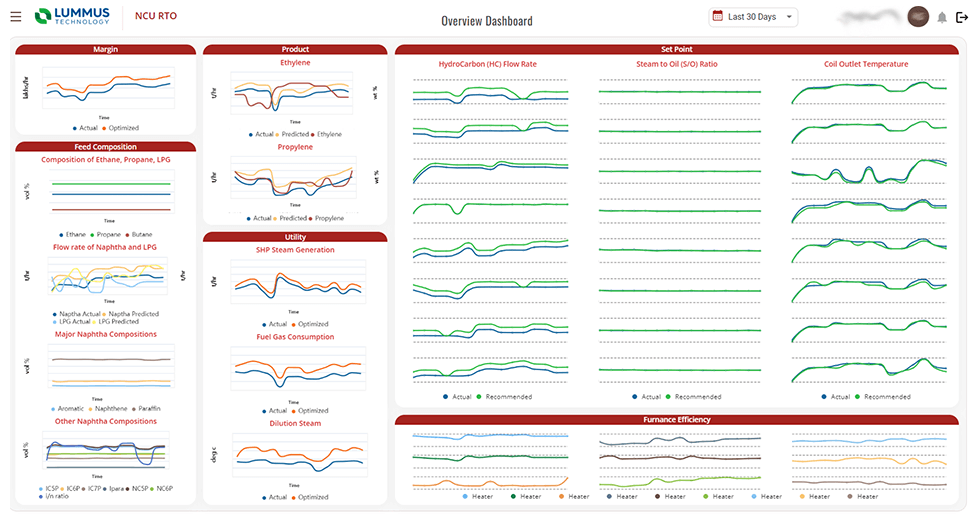
Designed to enhance the performance of the Naphtha Cracker, this solution utilizes an integrated First-Principles Simulation and AI/ML-powered platform that maximizes margin by predicting Product Quality in real time. Designed for process engineers and plant operators, it helps you run your unit at peak performance, maintain premium product quality, and unlock significant cost savings across your operations.
Pain Point
Struggling to boost throughput and profitability
Benefit
Optimize throughput and profit with precise Heater COT and Steam-to-Oil Ratio adjustments
Pain Point
Uncertainty in determining the ideal Heater COT setpoint
Benefit
Get accurate Heater COT set points tailored to your feed using optimizer insights and PYPS+ analysis
Pain Point
Unclear achievable yield for specific feed compositions
Benefit
Unlock insights with the Scenario Analysis feature, which provides the potential yield based on Naphtha feed composition
Performance Metrics
Performance Deviation Prediction
The PYPS+ Model takes the Plant Feed Composition, Feed rate, and the current DCS operating data as input
Key Parameter Monitoring
Process and Efficiency Trends
Based on the optimizer mode selection and the Scenario Analysis run (PYPS+), the RTO provides setpoints for the operator to achieve the desired results.
Operational Benchmarking
The model re-runs a scenario analysis after the optimizer run is complete to analyze actual results in PYPS+ once the changes are implemented.
Actionable Insights for Improvement
Margins are calculated for before RTO, with RTO, and after RTO to assess profit impact, and the results are published in a report.
Ethylene Heater
Optimization
Ethylene Fractionator
Optimization
Charge Gas Compressor (CGC)
efficiency monitoring
Ethylene Fractionator Optimization
This AI/ML-powered platform is designed to maximize ethylene product yield while minimizing ethylene slippage in the bottom ethane recycle stream. By leveraging real-time DCS data, it optimizes utility consumption and reduces ethylene vent rates. This solution ensures your column runs at peak efficiency—helping you achieve higher ethylene yield, reduce losses, and unlock significant cost savings across your operations.
Pain Point
Ethylene Product Loss & Heater Maintenance Issues
Benefit
Reduced Ethylene Slippage: Optimized reboiling and condensing operations push ethylene quality to spec limits, minimizing product loss
Pain Point
Increased Operational Cost due to higher Vent and Recycle rates
Benefit
Lower Vent & Recycle Rates: Reduced ethylene venting and ethane recycle with minimal slippage
Pain Point
Reduced Ethylene Recovery (Product-to-Feed Ratio)
Benefit
Maximized Ethylene Recovery: Optimized column operations leverage design specification margins to enhance ethylene product yield
Pain Point
High Refrigerant Consumption
Benefit
Optimized Refrigerant Use: Decreased refrigerant consumption and improved recovery through increased reboiling
Performance Metrics
Performance Deviation Prediction
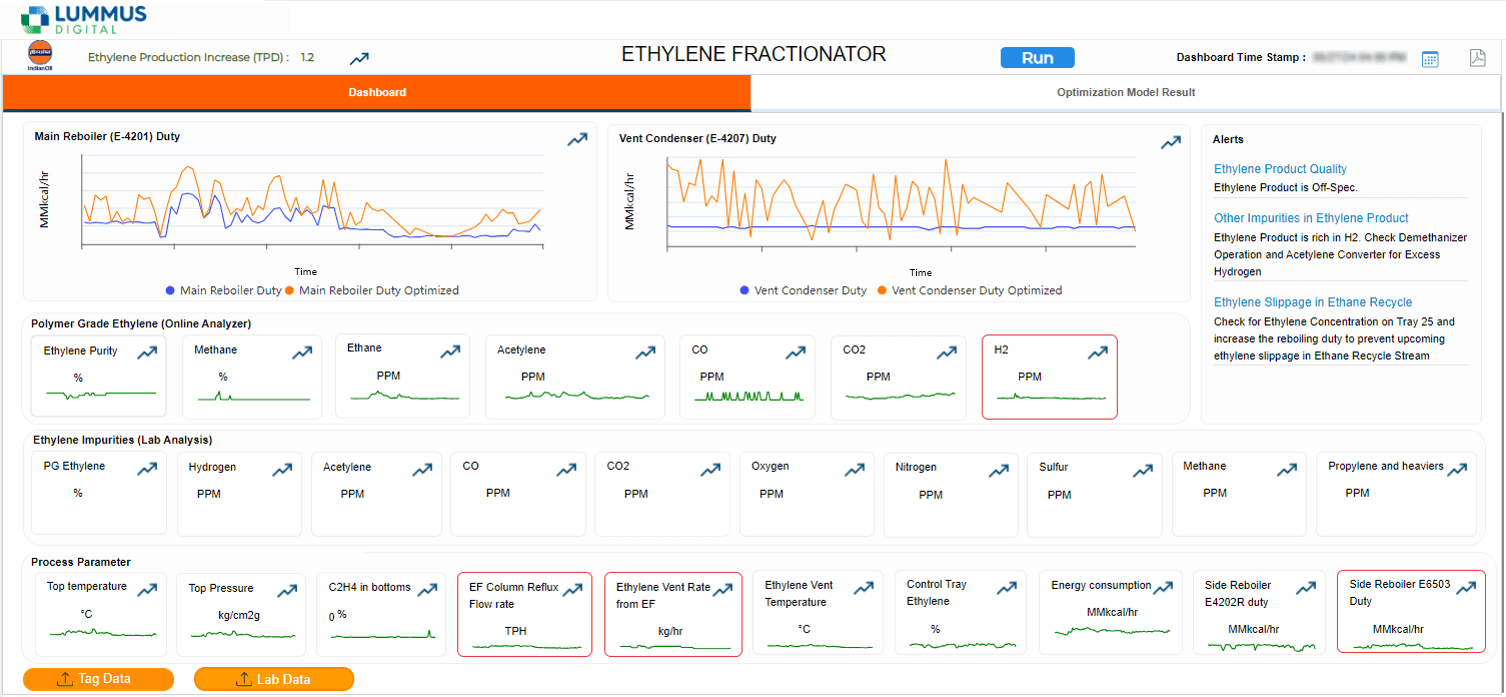
Takes the DCS and LIMS data with respect to the Ethylene Fractionator for further analysis and processing.
Key Parameter Monitoring
Process and Efficiency Trends
The alert indicates if the unit is operating normally (displays “Ethylene Product is on-spec”) or not, and provides recommended operator actions and upcoming event forecasts.
Operational Benchmarking
The model runs and publishes recommended values for operator-controlled setpoints to achieve lower vent rates, minimize ethylene slip, and maximize on-spec ethylene product rates.
Actionable Insights for Improvement
Displays a comparison plot of Current Operation vs. Optimized Operation on the dashboard to highlight potential areas for improvement.
Ethylene Heater
Optimization
Ethylene Fractionator
Optimization
Charge Gas Compressor (CGC)
efficiency monitoring
Charge Gas Compressor (CGC) efficiency monitoring
Optimize the operational performance of Charge Gas Compressors (CGC) by predicting and mitigating fouling issues in real-time. Our advanced hybrid model empowers process engineers to maintain optimal efficiency, reduce downtime, and drive cost savings across your operations.
Pain Point
Inability to Predict Fouling Issues in Real-time
Benefit
Real-time monitoring and predictive analytics identify potential fouling issues before they cause operational disruptions.
Pain Point
Difficulty in Managing Multiple Compressor Stages Simultaneously
Benefit
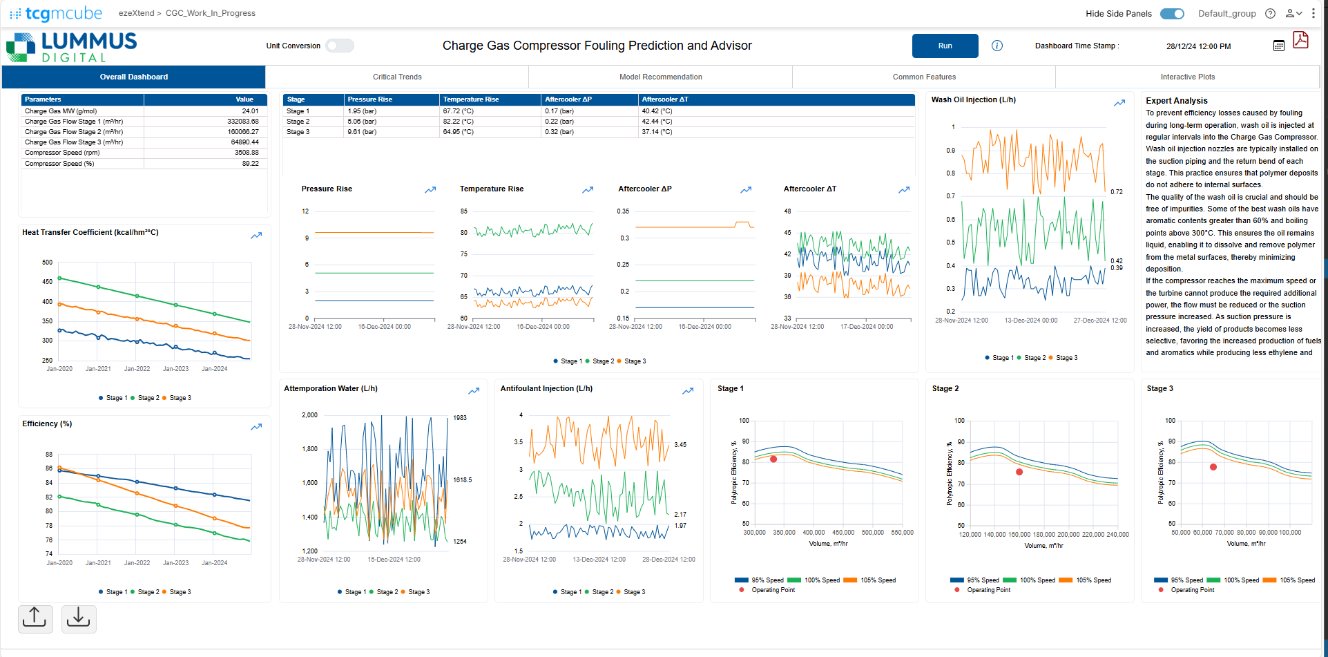
Monitor and manage up to six compressor stages, along with aftercoolers, through a comprehensive and flexible dashboard designed to meet your specific needs.
Pain Point
High Energy Consumption and Operational Inefficiency
Benefit
Optimize energy usage and enhance efficiency with actionable recommendations based on AI-driven insights and hybrid model approaches.
Pain Point
Unplanned Downtime and Increased Operating Costs
Benefit
Minimize unplanned downtime with predictive maintenance capabilities, reducing both costs and operational risks.
Performance Metrics
Performance Deviation Prediction
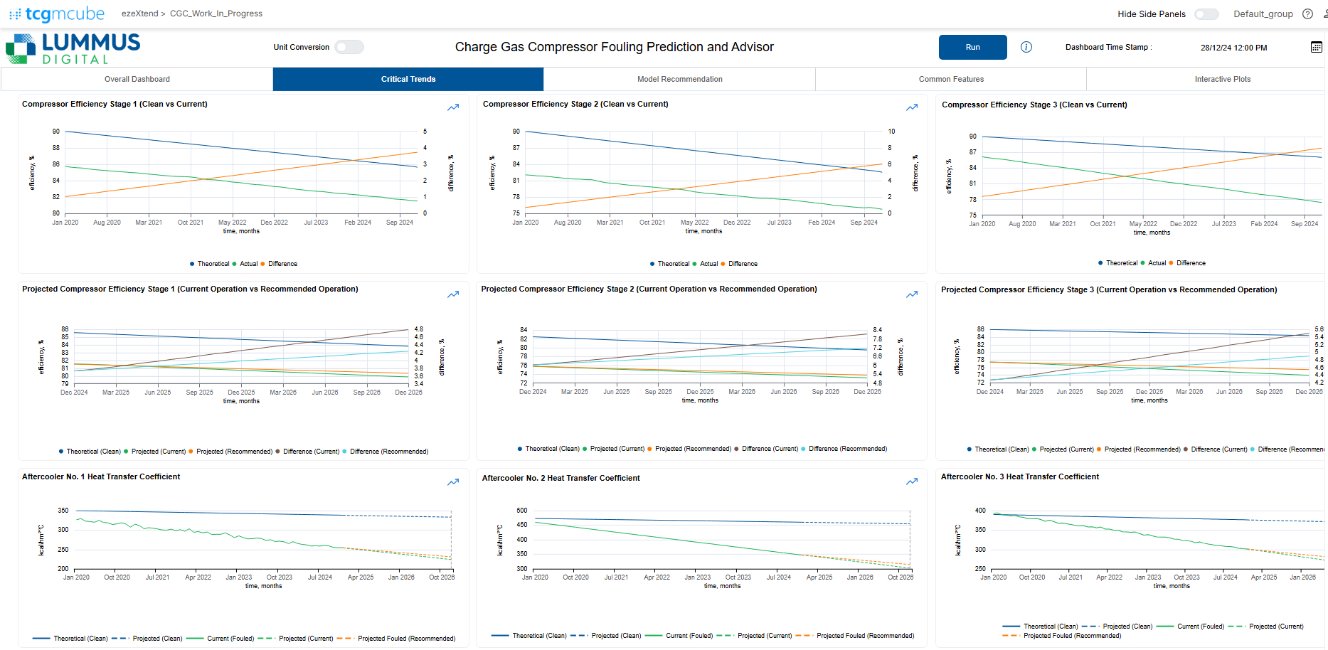
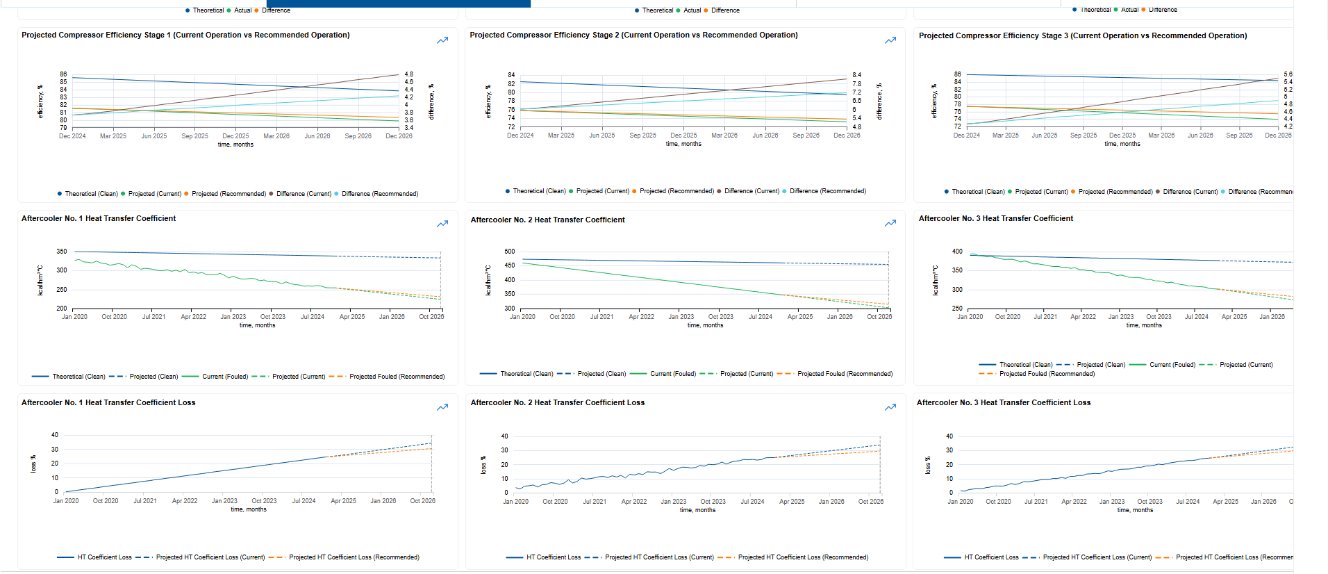
Predict the fouling rate at each compression stage along with the corresponding fouling rates for related intercoolers and heat exchangers, based on real-time operational data and conditions.
Key Parameter Monitoring
Stage-wise monitoring of compressor parameters, including pressure rise, temperature rise, after-cooler differential pressure (ΔP), and after-cooler differential temperature (ΔT)
Process and Efficiency Trends
Operational Benchmarking
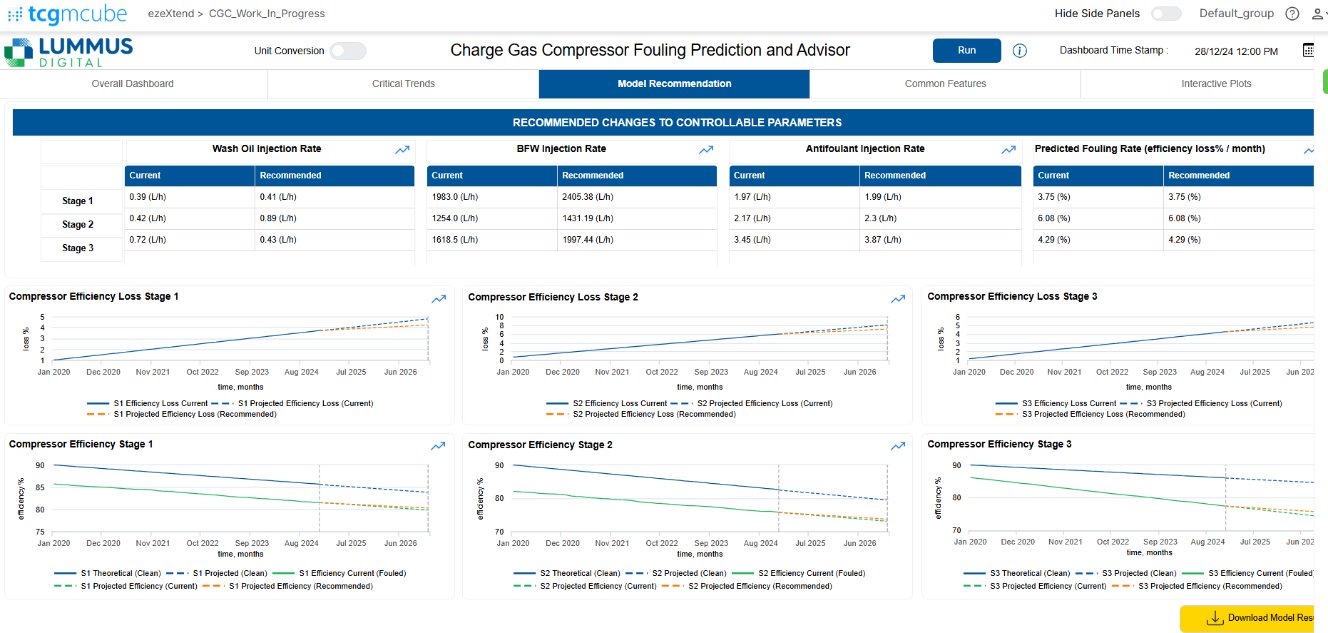
A comparison plot between “Current Operation” and “Recommended Operation” is displayed, allowing for a clear visual assessment of the two operational scenarios.
Actionable Insights for Improvement
Actionable recommendation (comparing with current values) on controllable parameters (each stage- wise) like Wash Water Injection, BFW Injection, Antifoulant Injection, and Fouling Rate.
Petrochemical operators can also benefit from digital solutions that address
fundamental operating issues such as:
Operational reliability
based on:

Anomaly
Detection
Using supervised and unsupervised machine learning, to determine contributing factors for the anomalous behavior of the equipment

Root Cause
Identification

Prediction of Failures Ahead of Occurrence
Using deep learning Long Short-Term Memory (LSTM) of the networks, the prediction of anomalies and remaining time before equipment failure

Best Optimal Solution Recommendation
Polymer production planning

Product Mix Optimization

Optimal Manufacturing Sequencing
Using the production plan, it further recommends optimal manufacturing sequence on the production line to reduce costs and improve time to market